
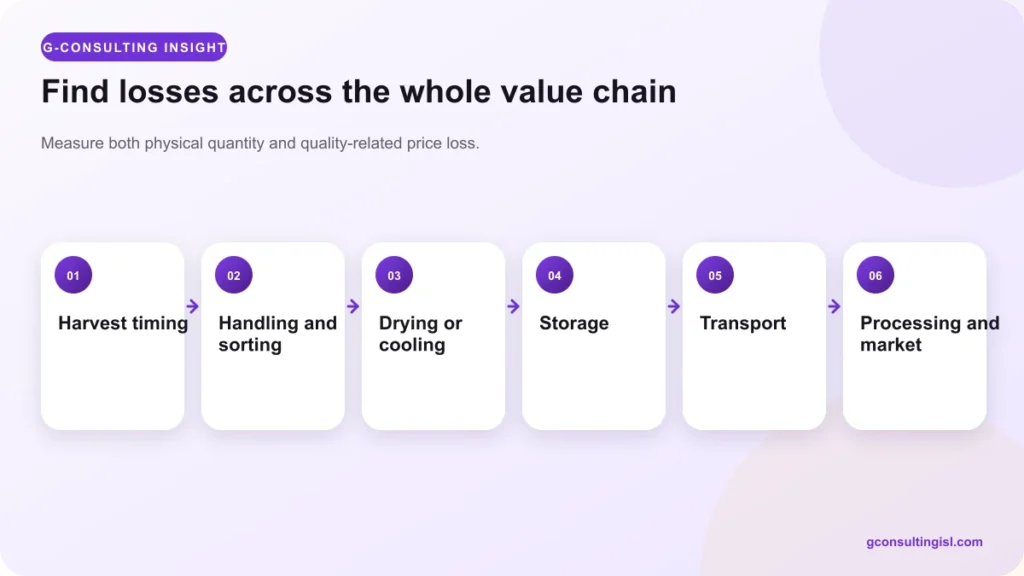
Post-harvest loss is not only food that disappears. It also includes bruising, moisture damage, contamination, pest attack, broken grain, temperature abuse and delayed sales that reduce the grade or price of a product. To reduce post-harvest losses in Nigeria, agribusinesses must manage the full journey from harvest to customer and measure both quantity and quality loss.
FAO identifies post-harvest loss, weak market access, limited technology and inadequate finance among the structural challenges facing Nigerian agriculture. The practical opportunity is that many losses are preventable through better timing, handling, infrastructure, information and accountability.
Map the product journey before buying equipment
Draw every step: harvest, field handling, aggregation, sorting, drying or cooling, storage, loading, transport, processing, packaging and sale. At each step record:
- quantity entering and leaving;
- time spent waiting;
- temperature or moisture conditions;
- handling method and container;
- quality grade and rejection reason;
- who owns the product and decision; and
- the price before and after the step.
This prevents a common mistake: investing in storage while the largest damage actually occurs during harvest, loading or transport.
1. Harvest at the right maturity and time
Harvest decisions affect shelf life and processing quality. Define a crop-specific maturity standard, prepare labour and containers before the harvest window and avoid leaving produce exposed while transport is arranged. For perishable crops, harvest during cooler periods where appropriate and move quickly into shade, sorting and cooling.
For grain, record field condition, variety, estimated moisture and any weather exposure. Mixing wet and dry batches makes drying and storage harder to control.
2. Replace damaging handling practices
Sacks may be convenient, but soft produce can be crushed by stacking, dropping and overfilling. Use clean, ventilated, stackable crates for suitable fruits and vegetables. Train handlers to lift rather than throw containers, limit stack height and separate damaged produce before it affects good product.
Clean contact surfaces, containers and vehicles. Keep produce off bare ground, away from fuel, chemicals, animals and dirty water. Food safety and loss reduction are connected: contamination can make an entire batch unsaleable.
3. Sort and grade close to the source
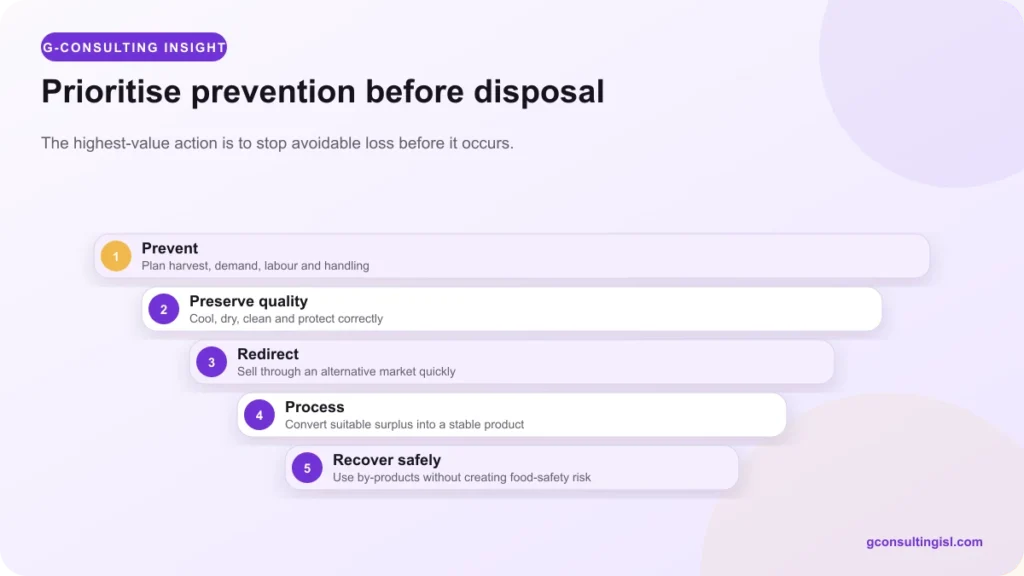
Remove damaged, diseased or unsuitable items early. Grade to the buyer’s specification rather than a vague idea of “good quality.” Separate products by size, maturity, variety and intended market. A product that misses a premium grade may still have value in processing or another market if redirected quickly and safely.
4. Control drying, cooling and moisture
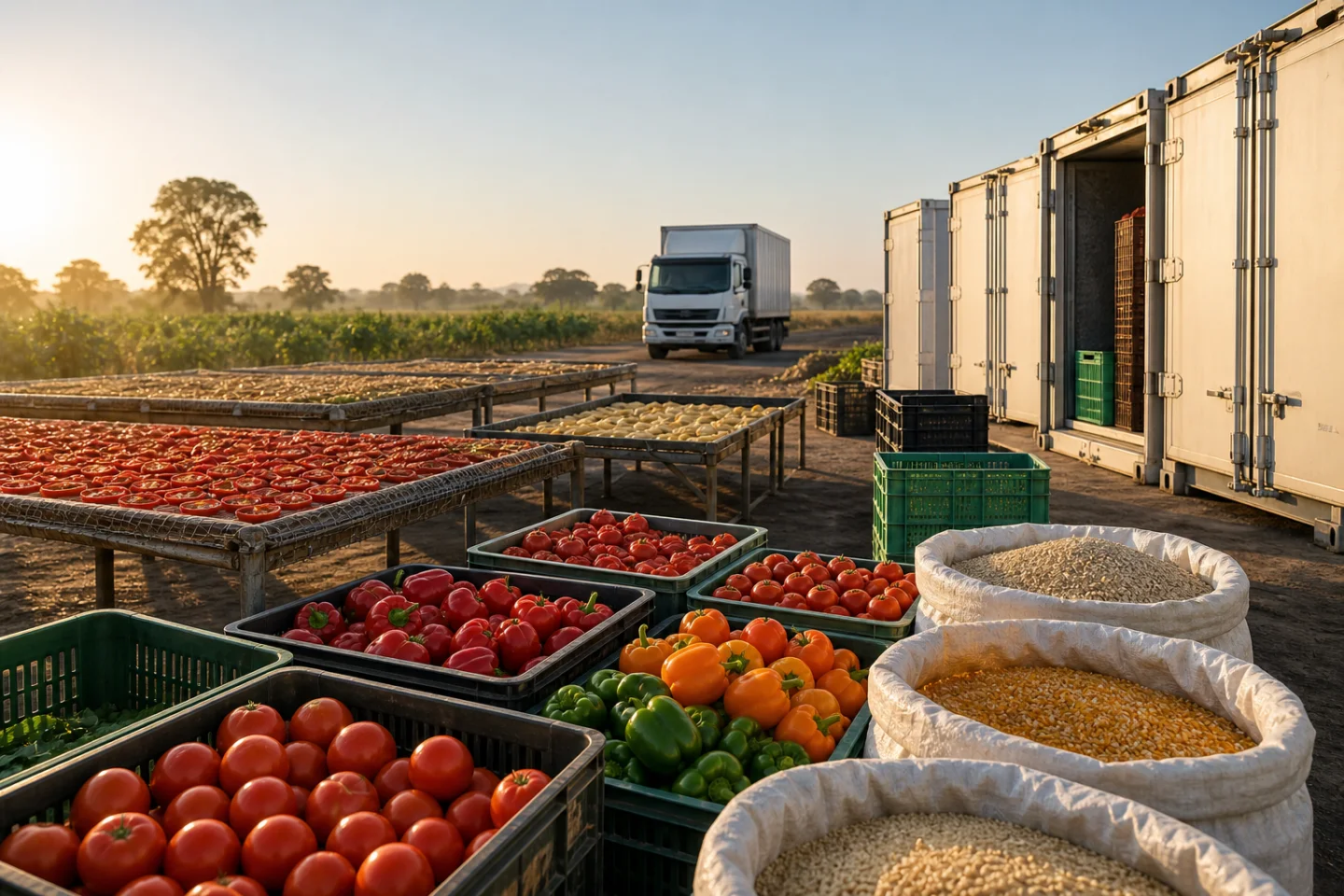
Perishables deteriorate quickly when field heat remains in the product. Use shade, airflow, evaporative cooling, cold rooms or refrigerated transport according to the crop, scale and market. Monitor temperature rather than assuming a cooling unit is working.
Grain and dried products need a defined moisture target, a calibrated meter and a documented sampling method. Dry on clean raised racks, tarpaulins or appropriate mechanical systems; avoid bare-ground drying. Drying too slowly can encourage mould and fermentation, while excessive heat or uneven drying can damage quality.
5. Design storage around the product
Storage must control moisture, heat, pests, contamination and stock age. Use pallets and clearance from walls, keep the roof and drainage sound, inspect for insects or rodents, and apply first-in-first-out or first-expiry-first-out rules. Hermetic systems may be suitable for properly dried grain, but sealing a wet product traps the problem.
Record lot identity, supplier, date, quantity, condition and movement. Without batch traceability, managers cannot connect a later problem to its source.
6. Treat transport as a quality-control step
Match the vehicle and packaging to the product. Plan route, departure time, loading pattern and delivery slot. Protect produce from rain and sun, avoid mixing food with contaminants, and reduce repeated loading and unloading. For cold-chain products, track temperature and define what happens after a temperature breach.
7. Align production with a real market specification
Loss increases when harvest arrives before the buyer, packaging or processing capacity is ready. Confirm expected volume, quality specification, delivery schedule, acceptance test, price basis and payment terms. Develop secondary channels before surplus appears, not during a crisis.
Build a simple loss dashboard
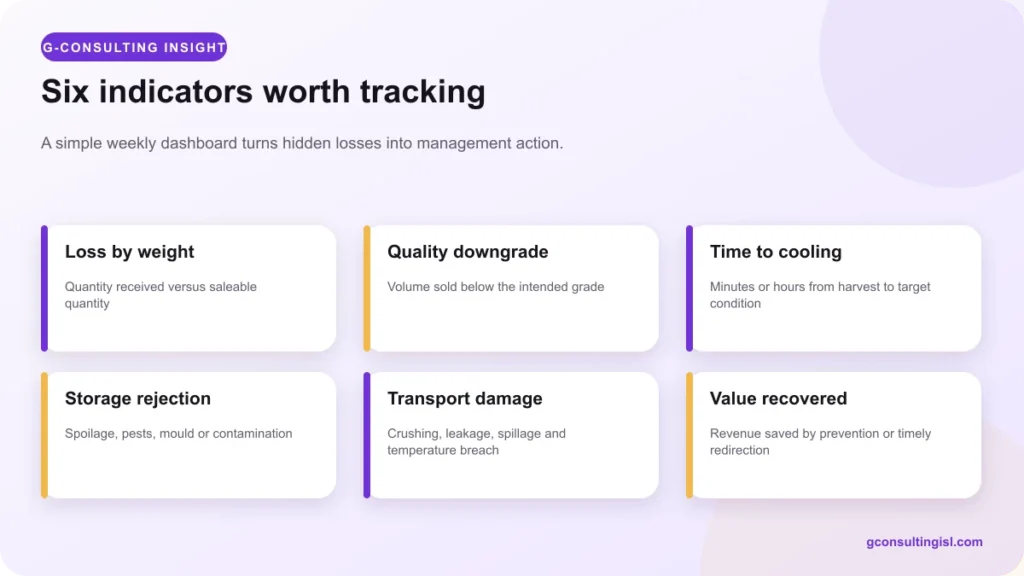
Track loss by crop, batch, stage, cause and value. Useful measures include:
- physical loss percentage = quantity lost ÷ quantity received;
- quality downgrade percentage;
- price loss between intended and actual grade;
- time from harvest to cooling, drying, processing or sale;
- storage or transport rejection by cause; and
- value recovered through prevention or timely redirection.
Review the dashboard weekly during the season. Assign corrective actions to named owners and check whether the loss moves to another stage after a change.
A 30-day improvement plan
- Week 1: map one product from harvest to sale and weigh inputs, outputs and rejects.
- Week 2: identify the top two loss points and agree a product specification with the buyer.
- Week 3: pilot one handling, drying, cooling, storage or transport improvement on a controlled batch.
- Week 4: compare loss, quality, cost and sale value with the baseline, then standardise what worked.
How to judge an investment
Do not justify equipment by its purchase price alone. Estimate how much product and price it can protect, utilisation across seasons, power and maintenance cost, operator skill, spare parts, finance cost and the market that will pay for the improved quality. A simple process change may outperform an underused machine; at a larger scale, dependable cold, drying, storage or processing capacity may be essential.
G-Consulting supports agricultural enterprise planning, value-chain improvement and processing strategy. Learn about our rice mill and agribusiness operations, explore our consulting capabilities or discuss a post-harvest improvement project.
Frequently asked questions
What is the difference between food loss and quality loss?
Physical loss reduces saleable quantity. Quality loss leaves product available but lowers its grade, safety, shelf life or price. Both should be measured.
What should a small agribusiness improve first?
Measure one product journey and target the loss point with the highest value and a feasible correction. Common starting points are harvest timing, containers, shade, clean drying, moisture control and stock rotation.
Will cold storage solve every post-harvest problem?
No. The cold chain must suit the product and remain controlled from loading to sale. Poor harvesting, contamination, packaging or market planning can still destroy value.
How often should loss data be reviewed?
During production or harvest season, review operational indicators at least weekly and investigate major deviations immediately.