

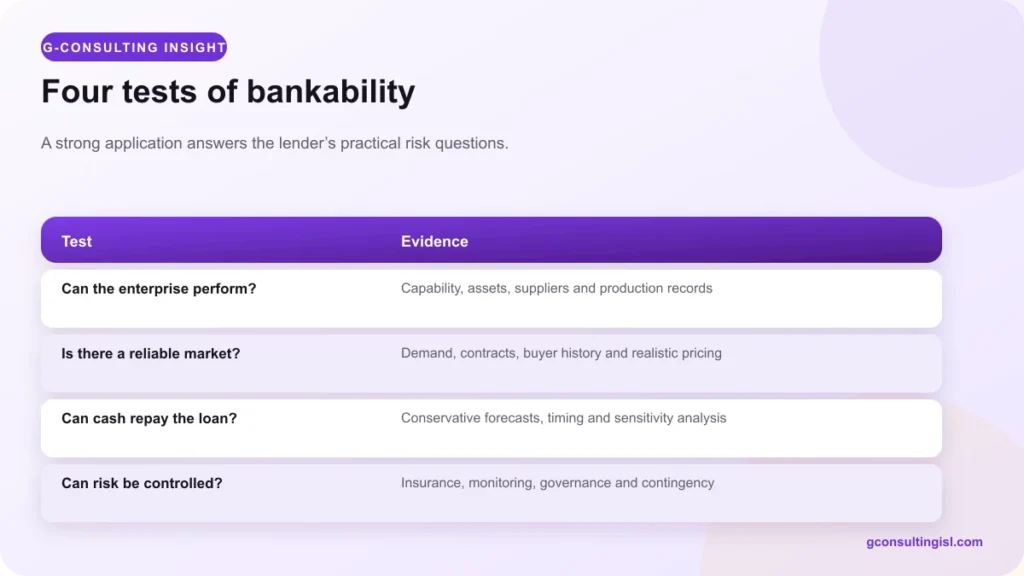
A lender does not finance passion alone. It finances a defined use of funds supported by a credible market, capable operations, transparent records, realistic cash flow and manageable risk. Building a lender-ready agribusiness in Nigeria means turning the enterprise into evidence a credit team can verify.
Bank of Industry application checklists illustrate the level of documentation lenders may request, including registration records, a business plan, quotations, financial accounts or statements, bank statements and existing liabilities. NIRSAL’s current finance-facilitation approach also emphasises bankability, business advisory, risk mitigation and structured value chains. Exact requirements vary by institution and product, so always use the latest official checklist.
1. Ask for the right kind of finance
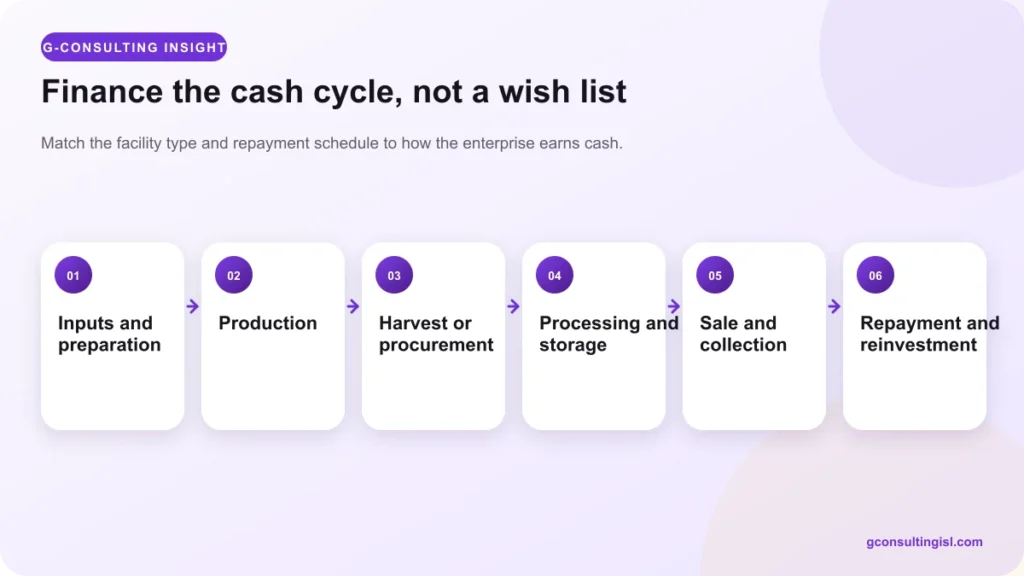
Define the amount, purpose, timing and repayment source. Working capital for seasonal inputs behaves differently from asset finance for a dryer, mill or cold room. A short-tenor facility with monthly repayment may not suit a crop that generates cash once after harvest.
Prepare a use-of-funds table with supplier quotations, taxes, transport, installation, training, working capital and the promoter’s contribution. Avoid a round figure with no connection to capacity or cash flow.
2. Make the enterprise legally and operationally visible
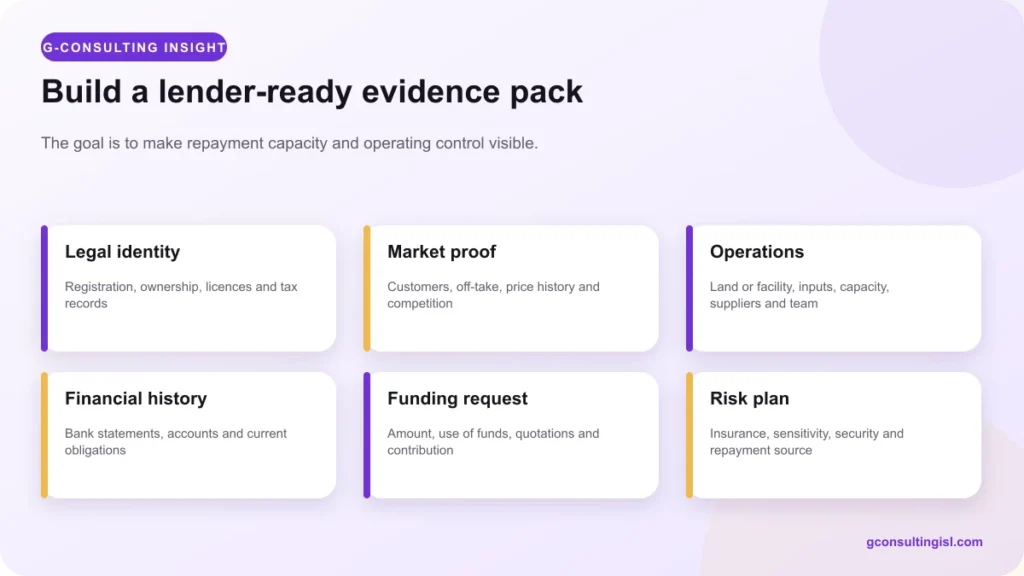
Keep registration, ownership, licences, tax records, identification, land or facility agreements and governance documents current. Separate business and personal transactions. Lenders need to know who has authority, where the enterprise operates and what obligations already exist.
3. Prove the market
A market statement should go beyond population size. Show target buyers, product specification, volumes, price history, seasonality, competitors, route to market, payment terms and evidence of actual demand.
Useful evidence includes invoices, purchase history, buyer correspondence, off-take agreements, distributor records and a pipeline with realistic probability. One unsigned expression of interest is weaker than repeat sales from several customers.
4. Explain the operating model
Map inputs, production or procurement, processing, storage, logistics, quality control and sale. State current and proposed capacity, yield assumptions, downtime, labour, power, water and maintenance. Identify key suppliers and substitutes.
For a farming enterprise, include location, crop calendar, agronomy, irrigation, mechanisation, expected yield and field monitoring. For processing, include raw-material catchment, conversion rates, quality specification, by-products and utilisation across the year.
5. Keep records a lender can reconcile
- Business bank statements
- Sales invoices and receipts
- Purchase and inventory records
- Production, yield and loss records
- Payroll and operating expenses
- Assets and existing liabilities
- Tax and statutory records
- Management or audited accounts as applicable
Numbers in the application, bank account and financial statements should tell the same story. Explain legitimate differences instead of adjusting figures silently.
6. Build a cash-flow forecast around the production cycle
Forecast monthly cash receipts and payments, not only annual profit. Include input timing, inventory holding, buyer credit, loan drawdown, interest, principal, tax, maintenance and a working-capital buffer.
Use conservative yield, price and collection assumptions. Prepare downside cases such as lower yield, delayed harvest, higher input cost, buyer delay or reduced selling price. Show what management would change and whether repayment remains possible.
7. Explain repayment capacity clearly
Identify the primary repayment source from operations and any secondary support. Debt should be serviced from realistic cash generation, not from a future loan that is not committed. Match repayment dates to cash receipts and allow for the operational cycle.
Collateral or a guarantee can reduce loss to the lender, but it does not repair an enterprise that cannot generate repayment cash.
8. Make risk control visible
Address production, climate, pest, price, quality, buyer, supplier, logistics, power, key-person and fraud risks. Controls may include appropriate insurance, irrigation, resistant varieties, multiple suppliers and buyers, quality testing, secure storage, preventive maintenance, segregation of duties and monitored accounts.
State residual risk honestly. A credible plan is more persuasive than claiming the enterprise has no risk.
9. Prepare for due diligence
Organise a digital and physical evidence folder with consistent file names, dates and version control. Assign one contact who can answer questions and provide documents. Expect verification of customers, suppliers, site, equipment, ownership, liabilities and promoter contribution.
Do not manufacture invoices, contracts or transactions. Inconsistency can end an application and damage future credibility.
10. Choose the right finance channel
Compare commercial banks, microfinance banks, development finance, leasing, supplier credit, off-taker finance, equity and risk-sharing programmes based on amount, currency, tenor, repayment structure, collateral, guarantee, fees and technical-support requirements.
NIRSAL works with financiers and agribusiness value-chain actors through credit-risk guarantees, finance facilitation and business advisory. Applicants should confirm current eligibility and process directly through official channels.
Pre-submission checklist
- The funding amount matches quotations and working-capital logic.
- Ownership, registration, tax and licences are current.
- Market evidence is specific and verifiable.
- Capacity, yield, utilisation and loss assumptions are supportable.
- Bank statements and accounts reconcile with the narrative.
- Monthly cash flow covers realistic debt service.
- Existing liabilities are fully disclosed.
- Downside scenarios and risk controls are documented.
- The evidence pack follows the lender’s current checklist.
G-Consulting supports agricultural enterprise planning, research, training and processing strategy. Explore our rice mill and agribusiness work, learn about our advisory capabilities or discuss an investment-readiness assignment.
Frequently asked questions
Do I need collateral before approaching a lender?
Requirements vary. Begin by showing a viable use of funds and repayment capacity, then confirm acceptable security or guarantee options with the specific institution.
Is a business plan enough?
No. The plan should be supported by registration, market, operational, financial and risk evidence that can be verified.
How many years of projections should I prepare?
Follow the lender’s requirement. Ensure the period covers the financing tenor and includes monthly detail where seasonality and working capital matter.
What causes avoidable delays?
Incomplete documents, inconsistent figures, undisclosed liabilities, weak market proof, unrealistic projections and slow responses to verification requests.