


Attendance proves that people joined a programme. Satisfaction proves that they liked some part of it. Neither proves that work improved. Measuring corporate training ROI requires a clear line from the business need to learning, from learning to behaviour and from behaviour to an operational result.
This does not mean every course must be reduced to naira. Compliance, safety, leadership readiness and organisational trust may create value that is important but difficult to monetise honestly. The goal is disciplined evidence: measure the right outcome at the right time and state what can and cannot be attributed to training.
Start with the performance question
Before delivery, write one sentence: “This programme is intended to help [audience] perform [critical behaviour] so that [business result] improves from [baseline] to [target] by [date].” If the team cannot complete that sentence, it is too early to promise ROI.
Examples include reducing avoidable rework, improving sales qualification, shortening approval cycle time, increasing first-time-right documentation, reducing safety deviations or improving supervisor feedback quality.
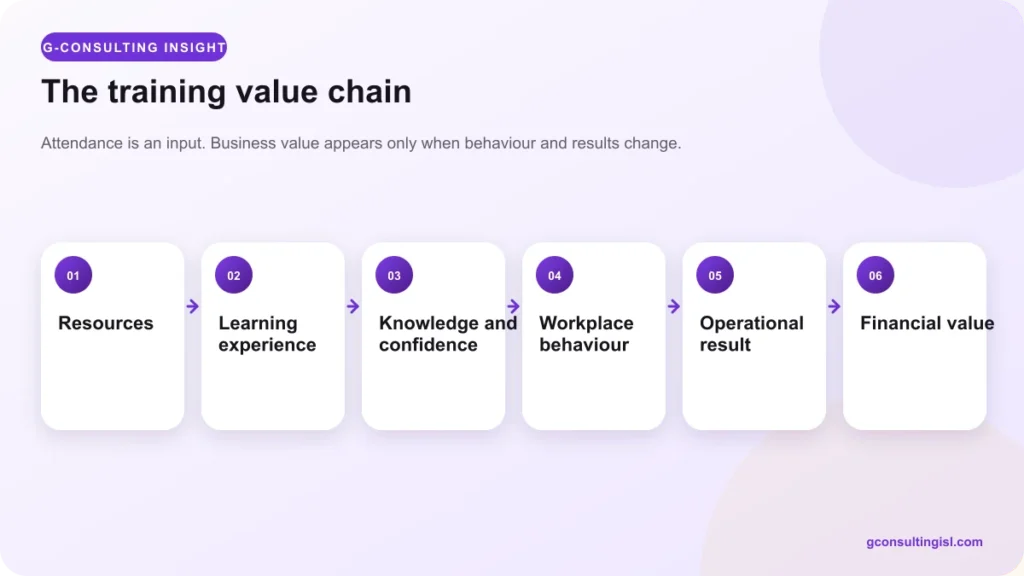
Build a training value chain
A practical value chain has six links:
- Resources: facilitator time, participant time, venue, travel, materials and technology.
- Learning experience: relevant instruction, practice, feedback and assessment.
- Capability: knowledge, skill, judgement or confidence demonstrated by participants.
- Workplace behaviour: observable use of the new method on the job.
- Operational result: a change in quality, time, cost, risk, customer experience or revenue.
- Value: the financial and non-financial benefit created by that result.
Weak programmes often measure the first three links and assume the rest. A credible evaluation tests the links most relevant to the investment.
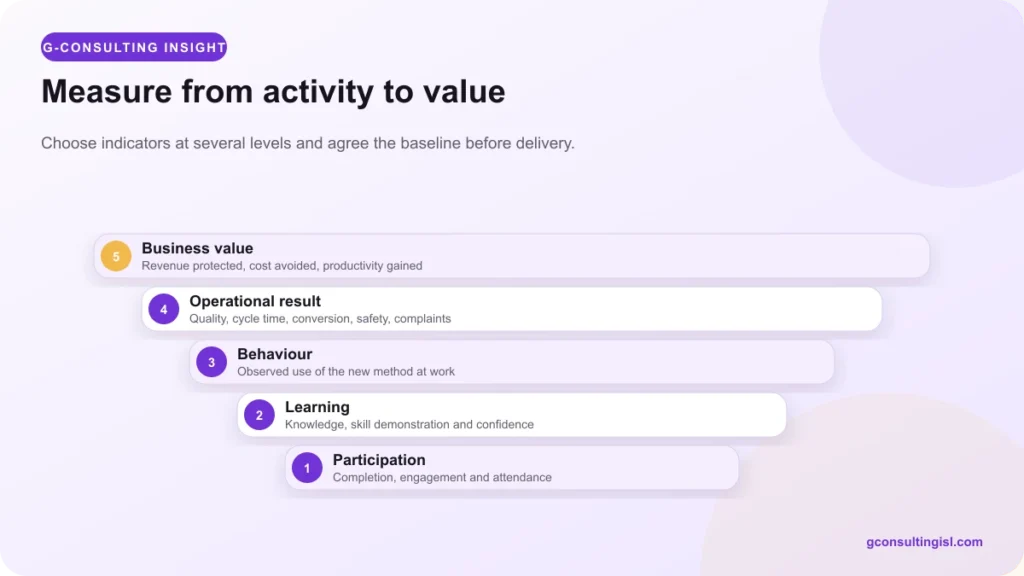
Choose indicators before training begins
| Level | Example evidence | Typical timing |
|---|---|---|
| Participation | Completion, attendance and engagement | During delivery |
| Learning | Scenario result, skill demonstration or knowledge check | Before and immediately after |
| Behaviour | Observation, work sample, manager check-in or system usage | Two to eight weeks later |
| Operational result | Quality, cycle time, error, safety, conversion or complaint data | One to three months later |
| Business value | Cost avoided, capacity gained, revenue protected or risk reduced | When results are stable enough to value |
Use a small set. Too many indicators create reporting work without clearer decisions. Each measure needs an owner, data source, frequency and agreed definition.
Establish a credible baseline
Measure the starting point with the same definition that will be used after training. A baseline can be a three-month average, a sample of recent cases or a structured observation of current practice. Note seasonality, product changes, staffing changes and other events that could affect the result.
If a customer-service programme aims to reduce repeat contacts, define what counts as a repeat contact, which channels are included and the observation window. Otherwise, teams may produce a “better” number simply by changing the calculation.
Measure behaviour where work happens
Post-course quizzes show recall. Behaviour evidence shows transfer. Useful methods include manager observation guides, quality-assurance sampling, call or case reviews, system workflow data, customer feedback and participant action logs. Keep the observation focused on a few critical behaviours that the programme taught and practised.
Managers need a role. They should set expectations before training, give participants an opportunity to apply the skill, provide feedback and remove obstacles. When the workplace discourages the new behaviour, the learning programme cannot carry the result alone.
Account for other influences
Training rarely happens in isolation. A new tool, revised pricing, a marketing campaign, staffing changes or seasonality may influence the same metric. Use practical methods to strengthen the conclusion:
- compare trained and not-yet-trained groups where this is fair and feasible;
- compare the trend before and after, not only two isolated dates;
- ask managers and participants to estimate the contribution of training and explain their evidence;
- review whether the specific taught behaviours changed before the result changed; and
- report important confounding factors openly.
Calculate the full programme cost
Include design and needs analysis, facilitator fees, venue, technology, travel, materials, participant time, manager follow-up, administration and evaluation. Excluding employee time may make a programme appear cheaper while hiding its largest cost.
When a defensible monetary benefit can be calculated, a common formula is:
ROI (%) = (monetary benefit − total programme cost) ÷ total programme cost × 100
For example, value may come from reduced scrap, fewer repeated transactions, capacity released by shorter cycle time or increased gross margin—not simply increased revenue. Use conservative assumptions, show the calculation and separate measured value from estimated value.
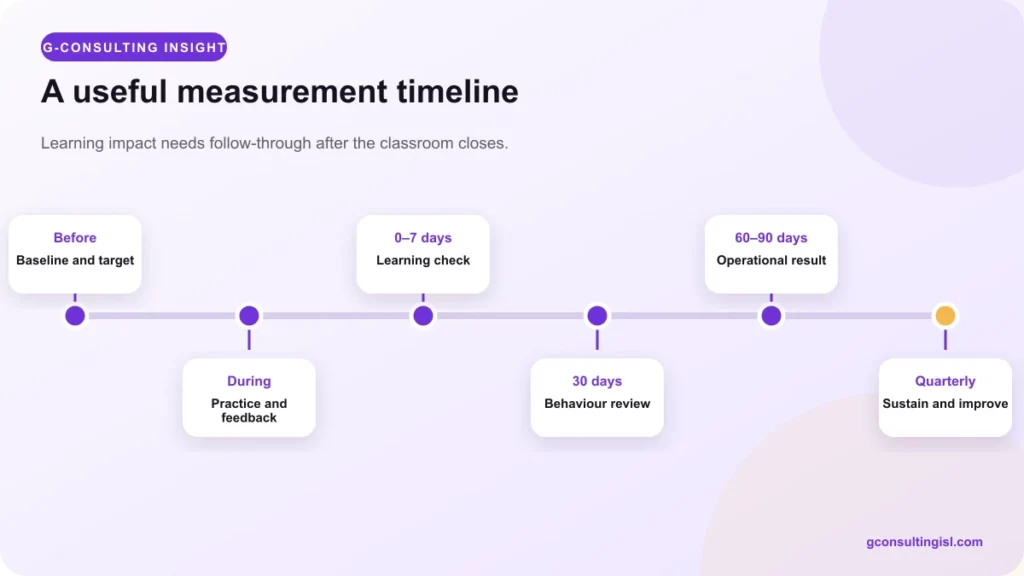
Use a 30–60–90 day evaluation plan
- Before delivery: agree the outcome, baseline, target, critical behaviours and data owner.
- During delivery: assess realistic practice and capture barriers participants expect at work.
- Within seven days: confirm learning, manager expectations and each participant’s application plan.
- At 30 days: review use of the target behaviour and address workflow or supervision barriers.
- At 60–90 days: examine the operational measure, contribution of training and sustainability.
- Quarterly where needed: reinforce, coach, update the process or retire content that no longer adds value.
A one-page training impact dashboard
Keep the report decision-ready. Show the business question, participants and roles, programme cost, baseline and target, learning evidence, behaviour evidence, result trend, other influences, financial and non-financial value, lessons and next action. Use plain language and link to deeper evidence rather than filling the page with activity counts.
Common measurement mistakes
- Waiting until after delivery to decide what success means.
- Using satisfaction as proof of performance.
- Measuring knowledge when the target is a practical skill.
- Claiming all business improvement as a training effect.
- Ignoring the manager and work environment.
- Forcing every benefit into money with weak assumptions.
- Collecting data that no decision-maker will use.
G-Consulting can help organisations diagnose capability needs, design practical programmes and build an evaluation plan that leaders can trust. See our training programmes, compare our Abuja learning facilities or start a conversation.
Frequently asked questions
Should every training programme have a financial ROI?
No. Every programme should have a clear purpose and evidence, but some benefits are better reported as risk, quality, readiness or compliance outcomes than forced monetary estimates.
How soon should training impact be measured?
Learning can be checked immediately. Behaviour and operational results need enough time and opportunity to appear; 30, 60 and 90-day reviews are useful starting points.
What if the organisation has weak performance data?
Use a small, consistent sample, structured observation or work-quality review to create a baseline. Improve the data process as part of the programme.
Who owns training impact?
The learning team coordinates measurement, but the business sponsor and line managers own the workplace result and the conditions required for application.


