


A training request often begins with a proposed solution: “Our team needs customer-service training,” “the supervisors need leadership training,” or “we need a digital-skills workshop.” The better starting point is the business result that is not being achieved. A training needs assessment in Nigeria turns that result into evidence, identifies the capabilities that genuinely need to change and prevents money being spent on a course when the real problem is a process, tool, incentive or management issue.
This guide gives HR teams, business owners, public institutions, NGOs and programme managers a practical method that works for a single department or a multi-location organisation. It is aligned with the International Labour Organization’s approach of mapping required skills against current capacity, while remaining simple enough to use without a large research team.
What a training needs assessment should answer
A useful assessment answers five questions:
- What organisational outcome or risk requires attention?
- Which roles and tasks influence that outcome?
- What should people know or be able to do?
- What can they demonstrate today, and what prevents better performance?
- Which gaps are important enough to address now?
The output is not a catalogue of popular courses. It is a prioritised learning brief with an audience, baseline, objectives, delivery constraints and measures of success.
Step 1: define the business outcome
Begin with a specific result. “Improve communication” is too broad. “Reduce avoidable customer escalations,” “increase first-time-right loan documentation,” or “improve safe handling of paddy at intake” gives the assessment something observable to investigate.
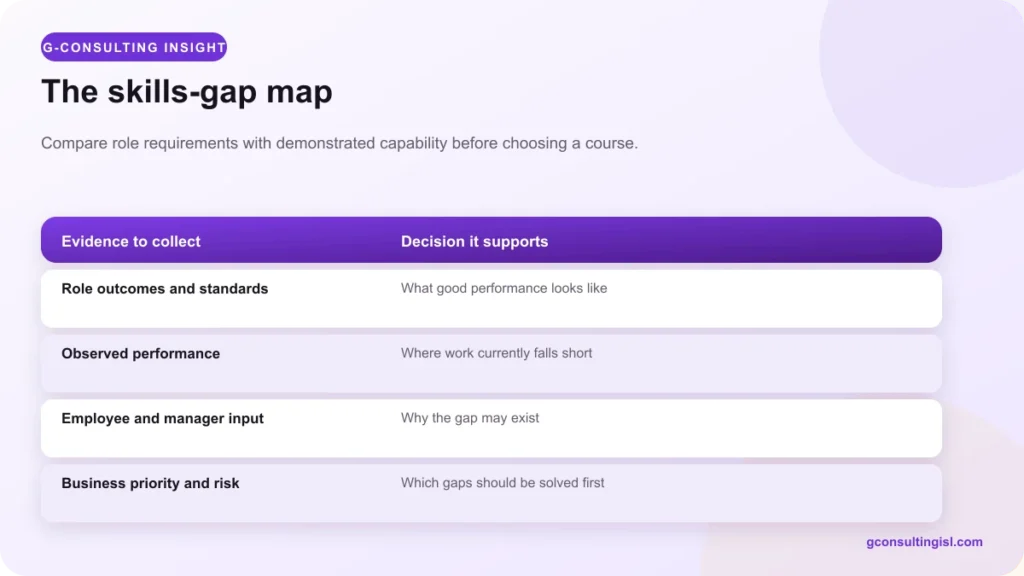
Ask the sponsor to describe the current result, the desired result, the people affected, the cost or risk of leaving it unchanged and the time available. Where possible, record a baseline such as error rate, processing time, repeat work, customer complaints, sales conversion, safety incidents or quality rejection.
Step 2: map critical roles and tasks
Do not assess everyone against one generic list. Map the few roles and work moments that have the strongest effect on the outcome. For each role, identify:
- the decisions the person must make;
- the tasks they must complete reliably;
- the standards, policies or customer expectations they must meet;
- the tools and information they need; and
- the behaviours that make performance sustainable.
This makes the assessment job-specific. A branch manager, service officer and back-office analyst may all influence customer experience, but they require different capabilities.
Step 3: collect evidence from several sources
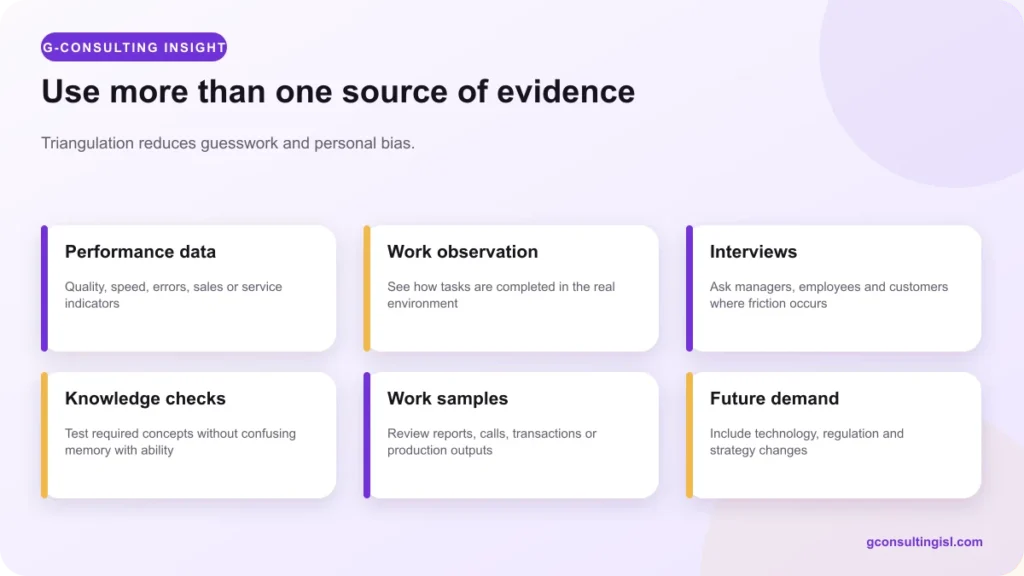
Surveys are useful, but self-reported confidence is not the same as demonstrated skill. Combine methods so the evidence can confirm or challenge itself.
| Method | What it reveals | Watch for |
|---|---|---|
| Performance data | Where and how often the result falls short | Poor data definitions or missing context |
| Work observation | What people actually do in the real workflow | People changing behaviour because they are observed |
| Manager and employee interviews | Constraints, causes and future needs | Opinion being presented as fact |
| Knowledge or scenario checks | Understanding and decision quality | Testing memory instead of workplace application |
| Work samples | Quality of reports, calls, records or products | Using a sample that is too small or unrepresentative |
| Customer or stakeholder feedback | The external experience of performance | Overreacting to one unusual case |
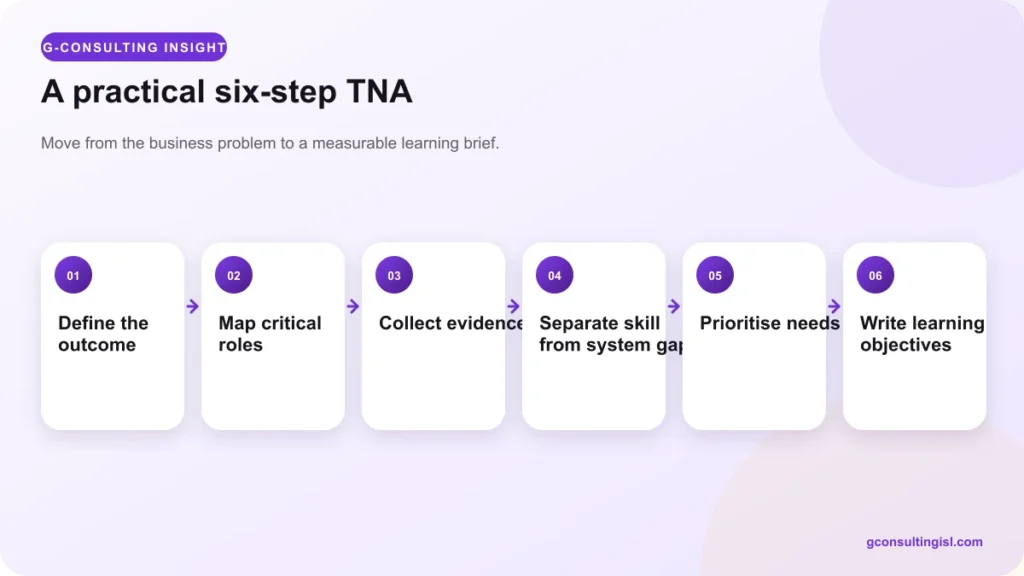
Step 4: separate a skill gap from a system gap
Training can improve knowledge, skill, judgement and confidence. It cannot repair a broken approval process, provide missing equipment, clarify a contradictory policy or reward behaviour that management discourages.
For each gap, ask: Could a capable person perform correctly in the current environment? If the answer is no, identify the operational change that must accompany or replace training. Common non-training causes include unclear expectations, weak supervision, insufficient authority, unavailable tools, unrealistic workload, poor data, conflicting incentives and a process that contains unnecessary steps.
Step 5: prioritise the needs
Score each proposed need against business impact, urgency, risk, number of people affected, ability to improve through learning and feasibility. A regulatory or safety gap may be urgent even when it affects a small group. A broad but low-impact preference may wait.
A simple 1–5 scoring grid helps stakeholders see why some needs enter the programme and others do not. Record exclusions as well as inclusions; this reduces scope creep later.
Step 6: write measurable learning objectives
Each objective should describe what participants will be able to do, under what conditions and to what standard. Replace “understand complaint handling” with “use the approved five-step complaint process to classify and resolve three realistic customer cases with no critical compliance error.”
The learning brief should also state the participant profile, prerequisites, preferred practice environment, accessibility needs, language considerations, delivery format, follow-up responsibilities and the measures that will be checked after training.
Questions to include in a Nigerian workplace TNA
- Which business result has changed, and when did the change begin?
- What do high performers do differently?
- Which errors or delays are most costly?
- What new technology, regulation, product or market condition is changing the work?
- Which employees need foundation, technical, interpersonal or leadership skills?
- What prevents employees from applying what they already know?
- What language, disability, location, shift or connectivity needs affect participation?
- What evidence would convince management that performance improved?
Common mistakes to avoid
- Starting with a course title. It narrows the diagnosis before evidence is collected.
- Asking only managers. Employees, customers and work samples often reveal different causes.
- Treating every weakness as a training issue. Pair learning with the process and management changes it requires.
- Ignoring future capability. Assess upcoming strategy, technology and regulatory needs, not only yesterday’s problems.
- Skipping the baseline. Without a starting measure, later claims of impact are weak.
- Designing for an imaginary average learner. Consider prior experience, literacy, language, accessibility and digital access.
A concise TNA deliverable
Your final document can be short. Include the business problem, scope, methods, evidence, root causes, prioritised capabilities, non-training actions, learning objectives, audience segments, recommended delivery approach, success measures, owners and timeline. Senior leaders should be able to see the decision logic without reading every interview note.
G-Consulting designs needs-led capacity-building programmes and supports organisations from diagnosis through delivery and evaluation. Explore our international and regional training services, review the G Learning Center facilities, or discuss a tailored assessment.
Frequently asked questions
How long should a training needs assessment take?
A focused departmental assessment may take days; an organisation-wide exercise may take several weeks. Scope, locations, data quality and the number of roles matter more than organisation size alone.
Is a staff survey enough?
No. Use a survey as one input and validate it with performance evidence, observation, interviews, scenarios or work samples.
Who should own the TNA?
HR or learning teams can coordinate it, but the business sponsor, role experts, managers and employees should jointly define performance and validate the findings.
What happens after the assessment?
Translate the priorities into measurable learning objectives, address non-training barriers, design practice and follow-up, then agree how workplace behaviour and results will be measured.


