


Digital transformation is not buying several applications and asking employees to adjust. It is redesigning how a business serves customers, controls work, uses data and makes decisions. A practical digital transformation roadmap for Nigerian SMEs starts with one costly bottleneck, improves it in a controlled pilot and expands only after the result is visible.
The World Bank has noted Nigeria’s digital potential alongside gaps in connectivity, skills and advanced business use of technology. SMEDAN’s current digital maturity assessment likewise considers technology, business processes, people, digital presence, data, transactions, cybersecurity and automation as connected dimensions. The implication for an SME is simple: tools, people, process and control must change together.
Choose one outcome for the first 90 days
Good starting outcomes include faster quote-to-cash, accurate inventory, fewer missed customer enquiries, quicker reconciliation, better field reporting or a reliable view of sales and margin. Avoid a vague objective such as “become digital.”
Use this test: can the owner name the current pain, affected users, baseline measure, desired result and process owner? If not, narrow the scope.
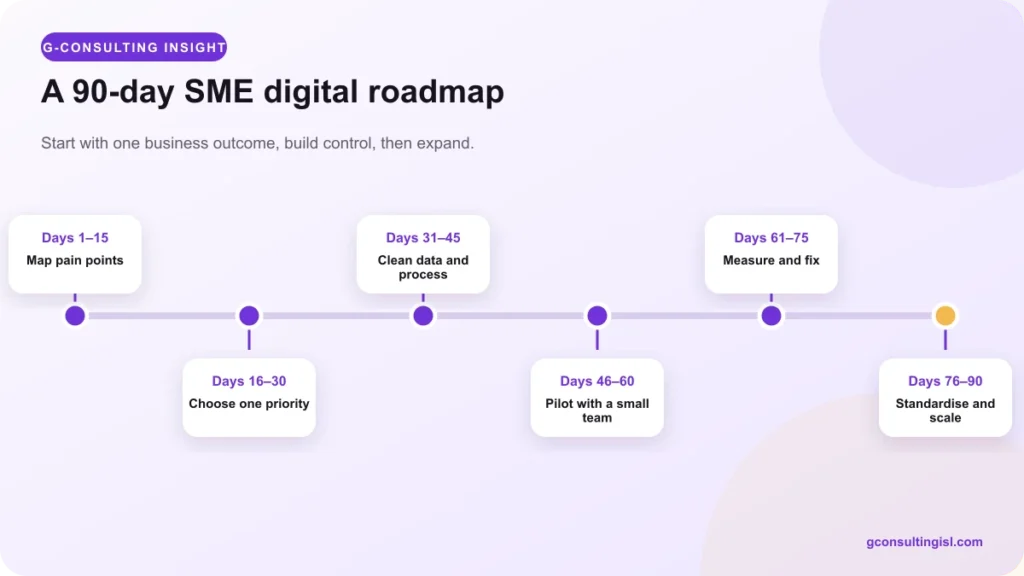
Days 1–15: map the real workflow
Follow a transaction from beginning to end. Watch how an enquiry becomes an order, how an order becomes delivery, how stock changes and how payment reaches the records. Capture spreadsheets, paper forms, messaging apps, approvals, repeated data entry and workarounds.
Measure the baseline: cycle time, errors, lost enquiries, stock variance, days to collect payment, repeated work or time spent preparing reports. Ask employees what slows them down and customers where they become uncertain.
Days 16–30: select the priority and owner
Score opportunities by customer or financial impact, frequency, risk, ease of improvement, data readiness and staff capacity. Choose one workflow with a named business owner. Technology can support the change; it cannot replace ownership.
Define a “minimum useful process.” Remove unnecessary steps before automating them. An inefficient approval chain does not become efficient because it appears on a screen.
Days 31–45: clean data and design control
Digital systems amplify the data they receive. Standardise customer names, product codes, prices, units, tax treatment, staff roles and document status. Decide who may create, change, approve, export and delete records.
Plan data migration, backup, retention and exit. The business should be able to export its records in a usable format. Do not lock critical history into an account that only one employee controls.
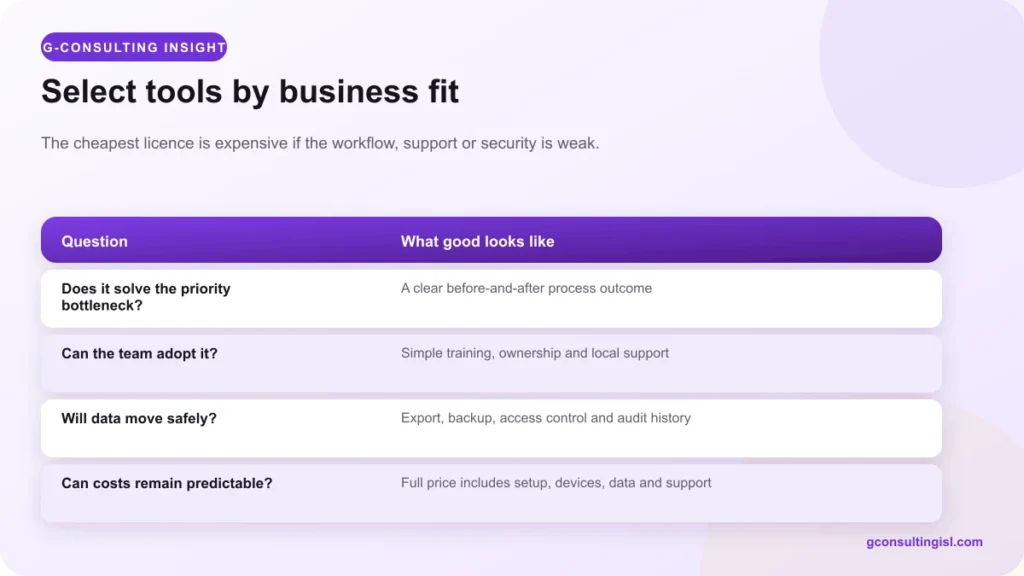
Choose technology by total fit
Compare options against the actual workflow, devices, connectivity and staff capability. Include:
- setup, licence, device, data, training and support cost;
- offline or low-bandwidth behaviour;
- user roles, audit history and multifactor authentication;
- data export, backup and integration;
- local support and response times;
- ability to grow without a disruptive migration; and
- privacy, security and regulatory requirements.
Run a demonstration using real scenarios and anonymised sample data. A sales presentation is not the same as a working pilot.
Days 46–60: pilot with a small team
Select representative users, not only technology enthusiasts. Train them on the new process, the reason for the change, security rules and what to do when the system fails. Use a controlled start date and a support channel.
Record issues by severity and cause. Do not run two “official” processes indefinitely; define when the new record becomes authoritative and how exceptions are handled.
Days 61–75: measure and correct
Compare the pilot with the baseline. Did the workflow become faster, more accurate or more visible? Are users completing the critical fields? Are customers receiving a better result? Did the change create a new bottleneck elsewhere?
Fix the process, permissions, training and integrations before adding more features. Remove fields and notifications that do not support a decision.
Days 76–90: standardise and scale
Document the approved workflow, responsibilities, access rules, exception handling, backup, recovery and performance measures. Train the next group using the corrected process. Set a review date and retire the replaced tool or paper process safely.
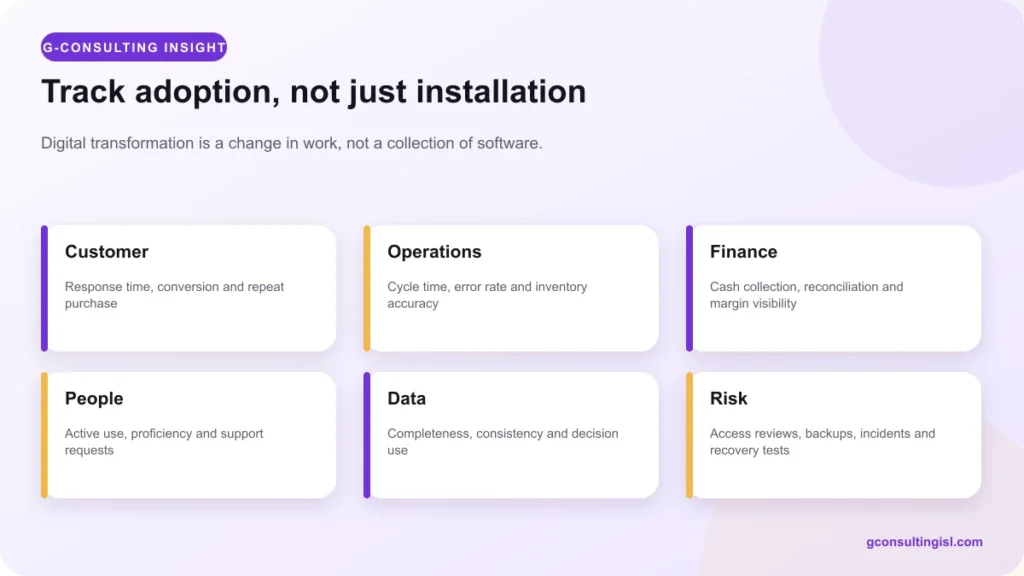
A balanced digital scorecard
| Area | Measures to consider |
|---|---|
| Customer | Response time, conversion, repeat purchase, complaints |
| Operations | Cycle time, error rate, order completion, inventory accuracy |
| Finance | Collection time, reconciliation, leakage, margin visibility |
| People | Active use, proficiency, support demand, workaround rate |
| Data | Completeness, consistency, timeliness and decision use |
| Risk | Access reviews, updates, backup tests, incidents and recovery |
Common reasons SME digital projects fail
- Buying a tool before understanding the workflow.
- Automating unnecessary approvals and repeated data entry.
- Ignoring data cleanup and ownership.
- Training users on buttons without changing roles and expectations.
- Depending on one administrator or vendor with no exit plan.
- Measuring installation instead of adoption and business results.
- Skipping privacy, backup and cybersecurity until after an incident.
What to digitise next
After the first workflow stabilises, select the next priority based on evidence. Customer management, inventory, procurement, finance, document control, field operations and management reporting can be connected gradually. Maintain one data dictionary and a small technology roadmap so short-term purchases do not create long-term fragmentation.
G-Consulting supports business process improvement, technology adoption, training and change. Explore our consulting capabilities, see our training services or discuss a practical digital roadmap.
Frequently asked questions
Does digital transformation require expensive software?
No. The first value often comes from clarifying a process, cleaning data and configuring a modest tool well. Cost should match the outcome and full operating requirement.
Which SME process should be digitised first?
Choose a frequent, costly bottleneck with a clear owner, usable data and a result that can be measured within a controlled pilot.
How do we improve staff adoption?
Involve users in workflow design, explain the purpose, practise realistic tasks, give support, remove duplicate processes and make managers use the same system.
What should happen before scaling?
Confirm the result, fix high-severity issues, document the workflow, set roles and controls, test backups and prepare training for the next group.